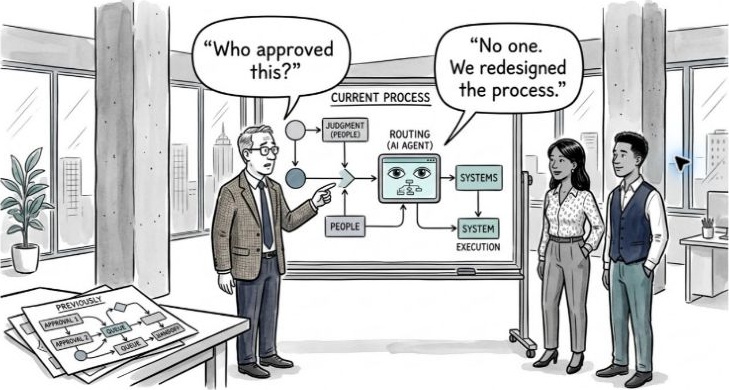
Microsoft recently made a point that should get the attention of anyone working in process improvement: redesign the work first, then apply AI.
In a May 2026 WorkLab article, Microsoft argued that organizations do not transform simply by deploying better AI models. The bigger opportunity comes from rethinking how the work itself is performed.
That becomes even more important as companies move from traditional automation toward AI agents.
Traditional automation usually starts with an existing process and asks:
Agents introduce a different question:
That is a very different starting point.
Microsoft's own agentic AI guidance now treats process transformation as a distinct part of AI adoption, alongside governance, value realization, architecture, operations, and organizational readiness.
And Microsoft's technology is beginning to reflect that thinking. Copilot Studio now combines structured workflows with agents that provide reasoning and adaptability, rather than treating the two as competing approaches.
For process leaders, that means the design conversation needs to get broader.
Before adding an agent, we should be asking:
- Which decisions still require human judgment?
- Which tasks could an agent own from beginning to end?
- Which handoffs exist only because people historically had to perform them?
- Where should information move automatically instead of waiting for someone to request it?
- Which controls remain necessary, and which need to change?
- What parts of the existing process may no longer be necessary at all?
This is where AI and business process management begin to converge.
The opportunity is not simply to automate more steps in an existing workflow. It is to reconsider the architecture of the work itself.
That also creates a risk.
If an organization takes a poorly designed process and simply adds agents to it, the result may be a faster and more sophisticated version of the same underlying problem.
We have spent years warning organizations not to automate bad processes.
Agents raise the stakes.
Because the next generation of process improvement may not be about deciding what to automate.
It may be about deciding what the process should become.