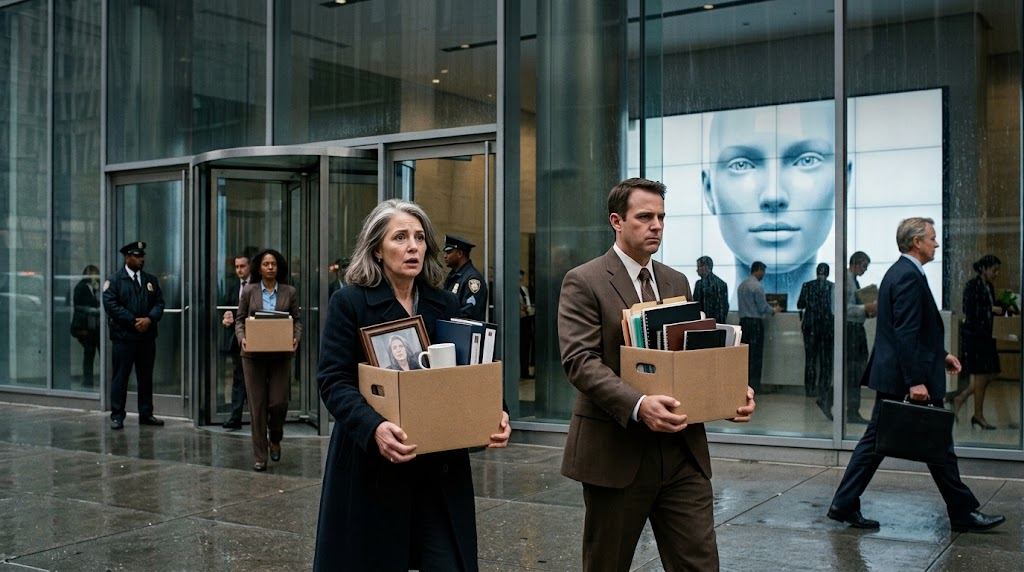
Experienced employees are often among the most expensive, so the logic can look compelling: remove high salaries, improve the next quarter, and buy time. In a genuine crisis, that may be necessary.
But when companies remove experienced knowledge workers, they are not only eliminating cost. They are eliminating context, judgment, customer history, pattern recognition, and an accumulated understanding of how the business actually works.
AI cannot use knowledge that no longer exists inside the organization.
The Knowledge Hollow
The term “knowledge worker” matters.
A knowledge worker understands why the work happens, how the pieces connect, which exceptions matter, and what happens downstream when a decision goes wrong. Some of that knowledge appears in processes and procedures. Much of it lives in the workaround that keeps a customer happy, the warning sign before a quality problem, or the judgment to know when following the standard process will produce the wrong result.
AI can summarize documents, recognize patterns, and generate options. It cannot recover institutional knowledge that was never documented, transferred, or incorporated into the design of the work.
If the real process left with the people who understood it, AI is being asked to automate an incomplete version of the business.
A Different Human-AI Operating Model
By the end of 2027, I believe the companies pulling ahead will be those that treated experienced judgment and the development of future judgment as productive capacity rather than overhead.
Experienced employees will help architect the work. They will define the objective, explain exceptions, identify risks, establish decision rules, and recognize when AI has produced something technically correct but operationally wrong.
Less-experienced employees will bring current technical fluency, challenge inherited assumptions, monitor AI output, and learn the architecture by participating in the work. Over time, they will develop the judgment required to improve and eventually own it.
The knowledge must move in both directions. Research on intergenerational work supports this model: experienced employees contribute company-specific judgment, while younger employees contribute current technical knowledge and new approaches.
AI becomes the accelerator between them. It does not replace either group.
Some Companies Are Already Building the Alternative
Wipro offers one of the clearest early examples. The company says AI has created productivity capacity equivalent to 20,000 employees. Instead of automatically treating those people as unnecessary, Wipro redeployed them into other projects, AI-agent supervision, and new roles. More than 100,000 employees have received advanced AI training as it builds a human-AI operating model.
The financial results remain unproven, but Wipro is treating AI-created capacity as something to redeploy before eliminating it.
Standard Chartered provides a financial case. The bank calculated that reskilling and redeploying an employee cost approximately $49,000 less than obtaining equivalent skills externally. Internal hiring increased from roughly 30 percent in 2023 to more than 50 percent by mid-2025, reportedly saving more than $55 million in recruiting costs and fees.
Its internal talent marketplace allows employees to contribute to projects outside their formal jobs, develop skills, and move toward future work. This is not a sentimental argument for retaining people. It is a commercial argument for preserving institutional knowledge while redirecting capability.
Trane Technologies provides the apprenticeship model. Facing an aging workforce and a shortage of HVAC technicians, Trane created a program in which senior technicians mentor apprentices. It expanded from 25 apprentices to more than 200 across 30 states in two years and reported an 86 percent retention rate.
Trane did not merely fill vacancies. It created a mechanism for converting experienced judgment into future capability.
Efficiency Today, Incapability Tomorrow
The danger is not that every experienced employee holds an irreplaceable secret. Organizations change, roles become obsolete, and some reductions are unavoidable.
The danger is cutting before understanding what capability is being removed.
AI can temporarily disguise the damage by helping fewer people produce more output. Eventually, the knowledge hollow appears. Decisions become less grounded. Exceptions multiply. Younger employees can operate the tools but cannot explain the system. AI-generated work circulates faster, but fewer people can determine whether it is useful, incomplete, or wrong.
A 2025 economics paper modeled this tension. It found that automating entry-level work can produce immediate productivity gains while weakening the transfer of tacit knowledge to the next generation. The paper is theoretical, but the warning matters: removing the work through which people develop judgment may reduce future productive capacity.
The OECD has similarly found positive productivity effects from a balanced workforce age structure and emphasized the value of retaining experience and firm-specific knowledge.
The Race Nobody Should Want to Win
The next workforce advantage will not come from choosing people over AI or AI over people. It will come from designing a system in which experienced knowledge workers architect better ways of working, developing employees learn how those systems work, and AI expands what both groups can accomplish.
Companies that build that model now will enter 2027 with the judgment required to direct the technology and a new generation capable of improving it.
Those focused only on removing expensive labor may arrive with impressive short-term savings and a serious capability problem: fewer people, more technology, and less understanding of the business they are trying to run.
Congratulations. You are now in the race to the bottom.
Psst. There is no prize worth winning for whoever finishes first.