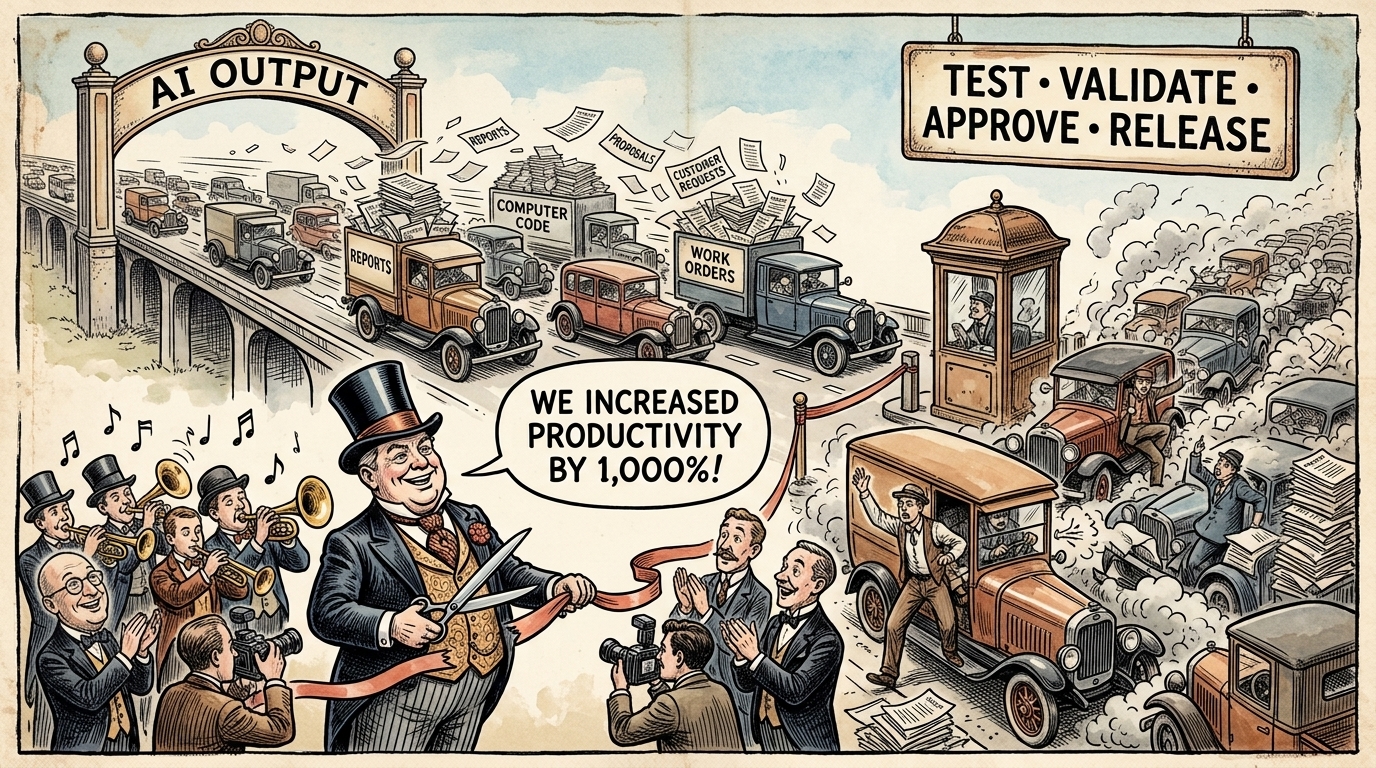
If one step in a process becomes twenty times faster while everything around it stays the same, you have not transformed the system.
You have created a queue.
That distinction is becoming more important as companies deploy AI tools and celebrate dramatic improvements in individual productivity. A task that once required several days may now take a few hours. A team can produce more analysis, code, proposals, reports, or customer responses than ever before.
But producing more work is not the same as completing more work.
Oracle Made Coding Faster. The Products Did Not Move Faster.
A recent Business Insider report on Oracle’s internal AI rollout provides a useful example.
Oracle executives said developers using AI could generate code in approximately a week that might previously have taken a team two or three quarters. That is an extraordinary improvement at the task level.
Yet the company was not getting products to customers at the same rate.
The added output shifted the constraint into testing, validation, deployment, and release management. Oracle could generate more code, but the rest of the operating system had not been redesigned to absorb it.
The technology worked.
The process surrounding it could not keep pace.
Local Productivity Is Not System Performance
Most AI business cases begin by measuring the activity being accelerated:
- Time required to draft a report
- Number of customer inquiries processed
- Volume of code generated
- Proposals produced per salesperson
- Work orders created
- Documents reviewed
Those measures can demonstrate that the tool is doing something useful. They do not tell leaders whether the business is producing better outcomes.
The real questions come next:
- Did the work reach the customer faster?
- Did quality improve?
- Was the backlog reduced?
- Did revenue increase?
- Did operating cost decline?
- Did employees spend less time correcting, checking, and coordinating the output?
That is where many early productivity gains disappear.
Boston Consulting Group’s 2026 AI at Work survey found that 42% of regular frontline AI users reported saving at least eight hours per week. However, 66% received limited or no guidance on what to do with the time saved, and more than half were not redirecting it toward more strategic work.
The same research found that 47% of respondents were spending more time managing and directing AI than doing the underlying work themselves.
AI may remove effort from one activity while creating new work in supervision, validation, exception handling, coordination, and governance.
That does not make the technology a failure. It means the work has changed, and the operating model must change with it.
The Bottleneck Usually Moves Downstream
This pattern is not limited to software development.
Imagine a manufacturer using AI to identify maintenance issues faster. If planning cannot prioritize the work, parts are unavailable, or technicians are already at capacity, the result is a larger maintenance queue.
- A field-service company may automate work-order creation, only to overwhelm scheduling and dispatch.
- A sales organization may produce proposals more quickly, while pricing, legal review, and contract approval remain unchanged.
- An insurer may accelerate the first notice of loss, only to send more cases into an already constrained adjuster review process.
In each case, the AI tool succeeds at its assigned task. The overall process still fails to produce additional value.
Sometimes it performs worse because the downstream team must now manage more volume, more exceptions, and more competing priorities.
Measure the Flow, Not Just the Tool
Before automating an activity, leaders should understand what happens when that activity becomes significantly faster.
Five questions can expose the next constraint:
- What additional volume will the technology create?
Faster work often means more work enters the next stage. - Where will that volume go?
Every output becomes someone else’s input, decision, or exception. - Does the downstream process have the capacity to absorb it?
Look at staffing, decision rights, systems, controls, and available time. - What new verification or coordination work will be required?
AI output may still need review, correction, escalation, or approval. - Which end-to-end business outcome should improve?
Measure cycle time, quality, cost, customer outcomes, throughput, or value realized, not simply tasks completed.
These questions should be answered before a company scales the technology, not after the new backlog appears.
Improve the Work Before Accelerating It
AI can create meaningful productivity gains. Oracle’s experience demonstrates just how significant those gains can be.
It also demonstrates why discovery must come before prescription.
The objective is not to make one activity perform at extraordinary speed. It is to improve the flow of work from beginning to end.
That requires examining the handoffs, decisions, controls, roles, capacity, and measures surrounding the technology. In some cases, the next investment should be more AI. In others, it may be a simpler approval process, clearer decision rights, additional testing capacity, or the removal of work that no longer adds value.
Automating the constrained step can increase throughput. Automating a step that is not the constraint may simply move the waiting somewhere else. AI does not eliminate the need for process improvement.
It makes poor process design move faster.