Three articles crossed my screen this morning. Each described a different way AI or technology could solve a meaningful business problem. The products were different, but the stories followed a familiar pattern: a difficult problem appeared, the technology was introduced, and a better outcome followed.
What was missing was everything that had to be true in between. There was little discussion of whether the underlying process was defined, whether the necessary data was accurate and accessible, whether an executive sponsor was accountable for the outcome, or whether the people doing the work were prepared to change how they operated.
The technology was presented as the answer without much examination of the operating conditions required for it to become one. That does not necessarily make the claims false. It makes them incomplete.
The Transformation Happens Off Camera
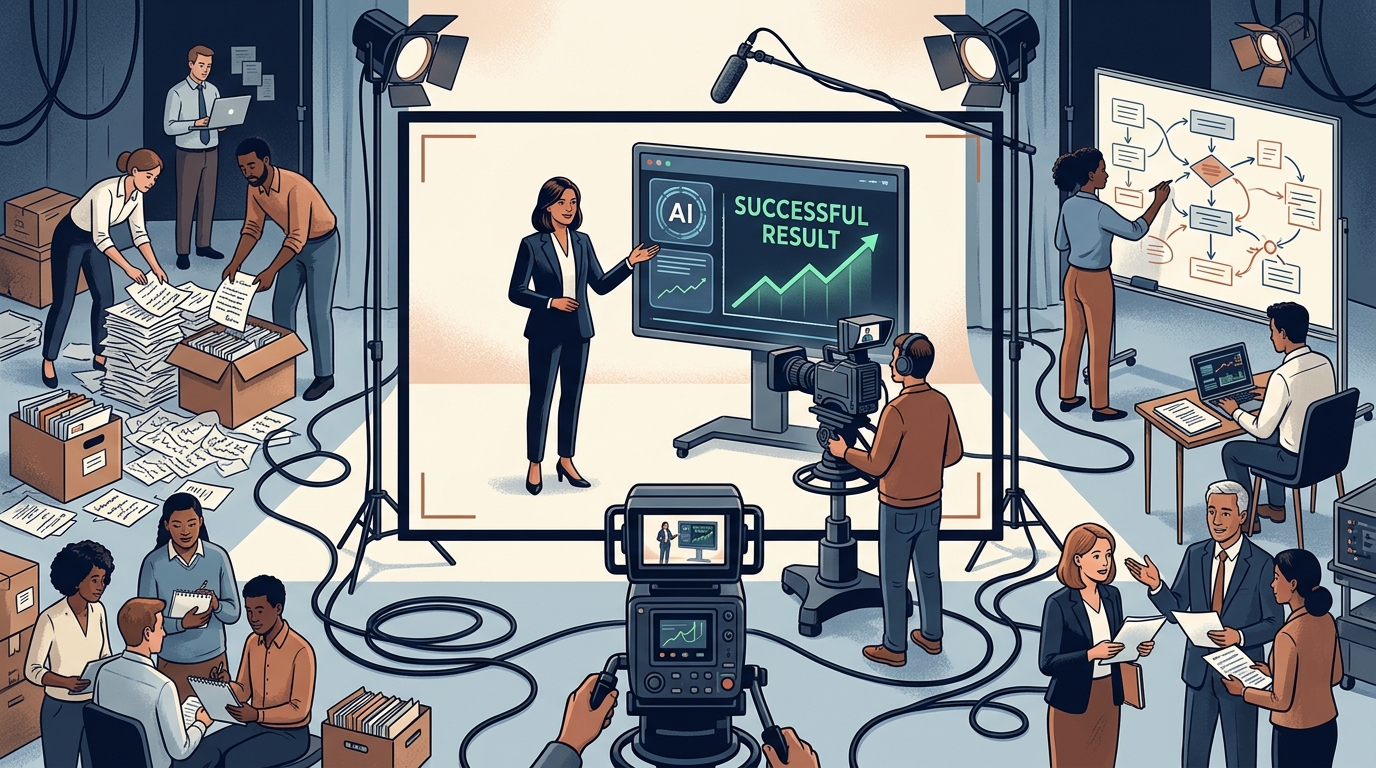
AI is beginning to resemble reality television. What appears on screen may have happened, but what viewers see is a highly edited version of events.
The setup is controlled. The unproductive moments disappear. Failed attempts are cut. Exceptional circumstances can look routine, and a result that required months of preparation can be compressed into a clean before-and-after story.
The same thing happens in many AI case studies and product pitches. We see the impressive demonstration, successful pilot, or headline result. We rarely see the work required to make it possible:
- Years of accumulated data that had to be cleaned, reconciled, and governed
- A process that was already reasonably stable and understood
- Subject-matter experts who helped define the rules and exceptions
- An executive sponsor with enough authority to remove barriers
- Workflow changes that clarified decisions, roles, and handoffs
- Training, adoption, controls, and ongoing maintenance
- Pilots that failed before the successful version was found
When those conditions are removed from the story, possibility starts to look like repeatability. An executive sees what another company achieved but cannot tell whether the same result is realistic in a different business, with different data, processes, leadership, and constraints.
That is where inspiration can quietly become misinformation.
A Capability Is Not a Business Outcome
Vendors have a legitimate reason to show what their products can do. A product demonstration is designed to make a capability visible, not to provide a complete transformation plan.
The problem begins when leaders treat evidence of technical capability as evidence that their organization is ready to produce the same business outcome. Those are two different questions.
An AI system may be able to interpret documents, recommend an action, predict demand, or automate a task. That tells us something important about the technology. It does not tell us whether the organization has the right data, whether the surrounding process makes sense, whether people will use the output, or whether the result will improve performance.
A successful demonstration proves that something can work under a defined set of conditions. It does not prove that it will work inside your operating environment.
Seven Questions That Separate Evidence From Entertainment
Executives do not need to become data scientists to evaluate an AI claim. They do need to ask about the parts of the story that usually remain off camera.
1. What business problem was actually solved?
Look for a clearly defined operational problem and a measurable starting point. “Improved productivity” is not enough. What changed, compared with what baseline, and why did that change matter to the business?
2. What condition was the process in before technology was added?
Was the work already documented, stable, and consistently performed? If the process was redesigned first, the improvement cannot automatically be attributed to the technology alone.
3. What data made the result possible?
Ask what data was required, how complete and accurate it was, and how much work was needed to prepare it. A solution built on years of clean, well-structured data may not transfer easily to an organization still reconciling spreadsheets and conflicting definitions.
4. Who owned the outcome?
Real transformation usually has both an executive sponsor and an operational owner. Someone needs the authority to change priorities, resolve conflicts, and hold the organization accountable for results.
5. What changed in the work itself?
Technology rarely creates value in isolation. Decisions, roles, handoffs, controls, and exception paths often have to change around it. Ask how the workflow changed and what people had to do differently.
6. How representative was the result?
Was this a controlled demonstration, a limited pilot, or a scaled implementation? How long did it run, how many users and transactions were involved, and what happened when the system encountered exceptions?
7. What did it cost to create and sustain the result?
The license price is only part of the economics. Integration, data preparation, process redesign, training, governance, monitoring, and maintenance all belong in the business case.
If those questions cannot be answered, the story may still be useful. It should be treated as a hypothesis worth investigating, not proof that the same outcome is ready to be replicated.
The Missing Ingredient Is Usually Not More Technology
The AI market is producing extraordinary capabilities, and business leaders should pay attention to them. But the widening gap between what technology can do and what organizations are prepared to absorb may be one of the defining management challenges of the next several years.
Closing that gap requires more than product selection. It requires discovery, process clarity, usable data, accountable leadership, thoughtful implementation, and a credible way to measure value.
The right question is not simply, “Can the technology do this?”
Leaders also need to ask, “What had to be true for it to work, and are those conditions true here?”
Until the industry shows more of what happens off camera, executives will have to demand the production notes.