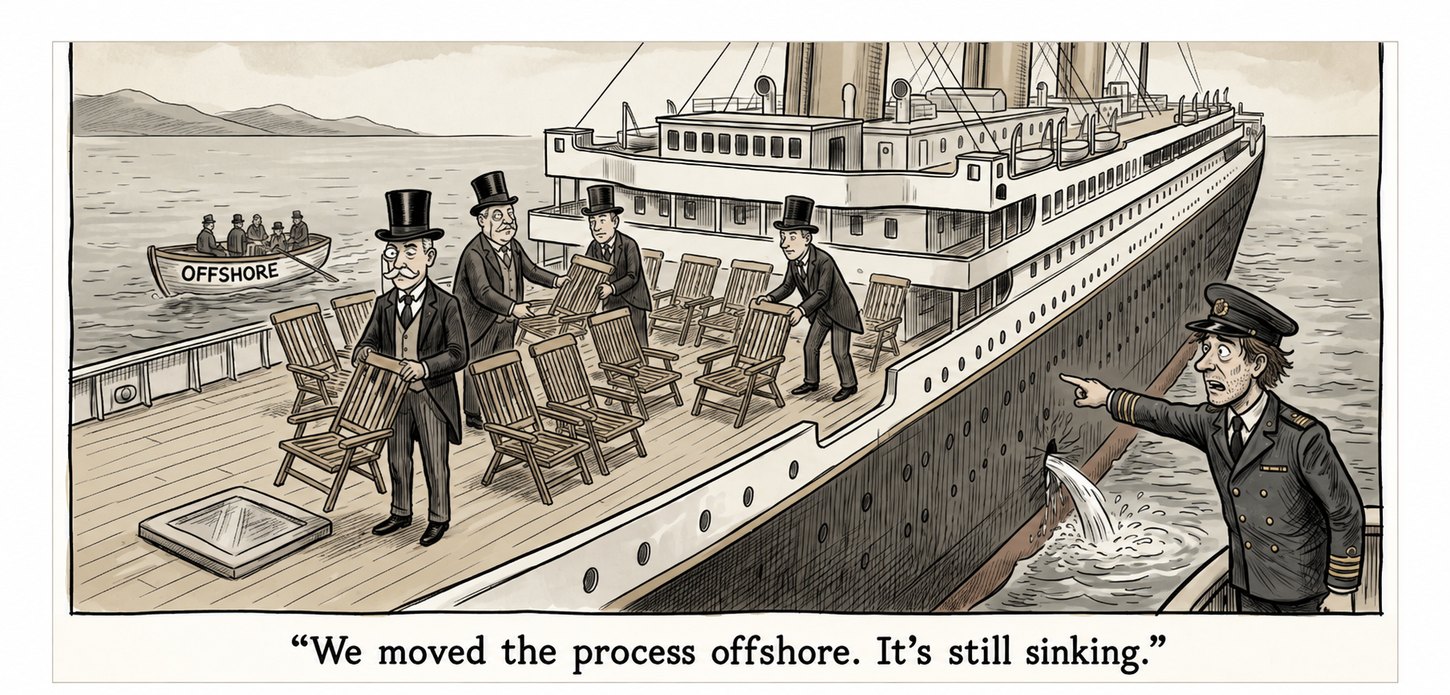
For years, shared services offered a clear economic case. Organizations could move whole functions to lower-cost locations, change the skill mix and capture visible savings.
I’ve been thinking about whether that logic still holds. I helped set up a global shared services center last year, and the question came up again this spring. Both times, I wondered whether we were reaching for a model built for a different era.
The Work Has Changed
Many AI initiatives don’t move a whole function. They automate pieces of work spread across existing roles.
A tool might save time on one task and more on another. Those gains can add up, but how do we know the organization captured the benefit?
If we don’t remove steps, reassign the work or deliberately put the freed capacity toward something else, it can be absorbed into the business. Parkinson’s Law still applies: work expands to fill the time available.
Connect the Organization
A recent Express Computer profile of RJ Corp’s digital transformation describes a common digital backbone, including centralized IT and a shared ERP platform, alongside tools that put data and decision support closer to people across the business.
That’s a useful distinction. The opportunity in an AI-first world is to connect data across functions and systems, so people and AI can work from shared context wherever decisions need to happen.
AI may provide some of the connective tissue that shared services were designed to provide. The value comes from making information useful across the organization, not from changing the location of every activity.
An Experiment Becomes an Operating Asset
A workflow or agent may start as an experiment, but once it connects to email, financial records, databases or customer systems, it becomes part of the operating environment.
It needs an owner, an inventory record, defined access boundaries, a patching path, monitoring and a decision about when to retire it. Otherwise, an experiment can quietly become infrastructure without anyone taking responsibility for its full lifecycle.
Decide Where the Benefit Goes
Before launch, leaders should be able to answer:
- Which steps or tasks will go away?
- What work will change hands?
- Where will the freed capacity go?
- How will we measure whether the process improved?
- Who owns the workflow, its access and its ongoing support?
AI can change where work happens and how it gets done. The operating model determines whether that change creates lasting value.
Where will the capacity created by your next AI initiative go?