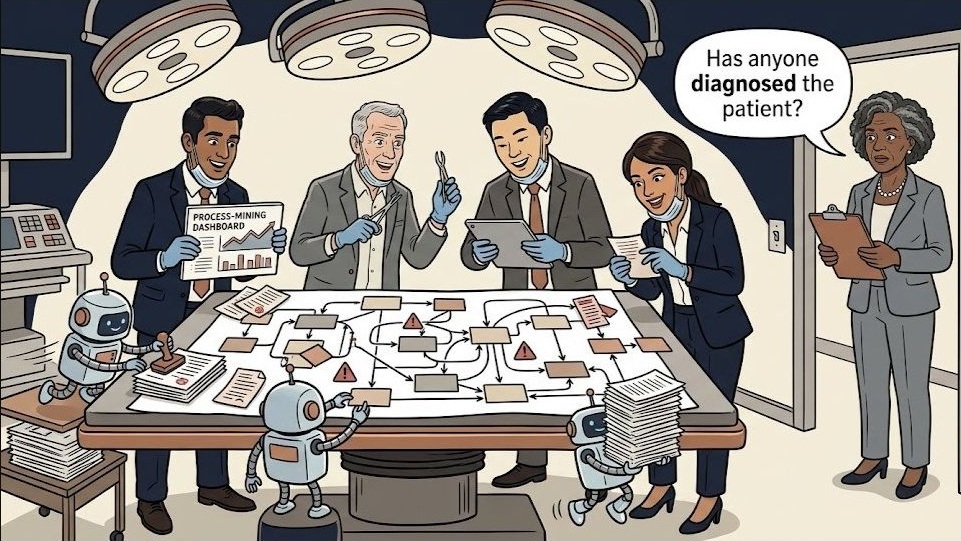
My son is studying business at Virginia Tech and recently told me that he is taking a course in process optimization. Naturally, I was interested. Process improvement has been a substantial part of my career, and I am curious about how the next generation is being taught to approach it.
His course also got me thinking about something happening more broadly.
Process redesign is suddenly everywhere.
As organizations struggle to turn AI investments into measurable results, consulting firms and technology vendors have rediscovered the importance of understanding how work gets done. Articles routinely explain that companies should redesign processes, rethink workflows, and focus on business outcomes before introducing AI.
That is good advice.
It is also advice that experienced process professionals have been giving organizations for decades.
The renewed attention is welcome. What concerns me is the growing impression that a new tool, short methodology, or impressive process map can substitute for the judgment required to diagnose and redesign a process properly.
Years ago, I saw a television commercial that captured this distinction perfectly.
A man was sitting at home, speaking by telephone with an emergency-room physician. The doctor calmly instructed him to take a knife and make an incision between two ribs. The man looked down at the knife, uncertain about what to do next.
He had received an instruction. He had not suddenly become a surgeon.
That is increasingly how I feel about some claims surrounding process improvement today.
Process-mining tools can provide valuable information. They can identify variations, delays, rework, loops, handoffs, and exceptions within the activity recorded by an organization’s systems.
The software does not know which process deserves attention or whether its boundaries have been drawn correctly. It cannot fully explain why employees created workarounds, how incentives influence behavior, or whether an apparently inefficient step exists for a legitimate reason.
Nor can it determine whether the process should be improved, simplified, consolidated, eliminated, or completely reimagined.
Those decisions require context, investigation, and judgment.
They also require selecting the correct level of analysis. A team can improve individual tasks while missing the constraint governing the entire system. It can remove a delay in one department only to create more work elsewhere. It can optimize what is easy to measure while ignoring what matters to the customer or the business.
This is not an argument against process mining, AI, or any other technology. These tools can make experienced practitioners substantially more capable. The problem begins when access to the instrument is mistaken for the ability to operate.
We have seen this story before.
During the rapid expansion of robotic process automation, organizations were promised quick savings from automating repetitive activities. RPA sometimes delivered real value. In other cases, companies automated work that should first have been questioned, simplified, or eliminated.
The bot performed the task faster, but nobody stopped to ask whether the task should still exist.
AI is creating a similar temptation on a much larger scale. Organizations see what another company reportedly accomplished and begin searching for places to deploy the technology. The tool becomes the starting point. The business problem, operating context, and ability to capture value are investigated later, if at all.
When an initiative stalls, the organization often concludes that the technology failed. Frequently, the technology did what it was asked to do. It was simply placed inside a process that had never been properly understood or redesigned.
McKinsey, BCG, and others now argue that organizations must rethink end-to-end work instead of inserting AI into existing processes. Again, that advice is correct.
But AI did not suddenly make process redesign important. It made years of neglected process discipline more visible and considerably more expensive.
The answer is not to reject the tools or dismiss the people learning to use them. The next generation of process professionals will have analytical capabilities earlier practitioners could only have imagined. That should make their work more powerful.
It should not make any of us overconfident.
Strong process improvement still begins with disciplined questions:
- What outcome are we trying to improve?
- Why was this process selected?
- Where does it actually begin and end?
- What do the systems record, and what happens outside them?
- Which activities create value, and for whom?
- Where is the real constraint?
- What unintended consequences could the proposed change create?
- How will we know whether it produced measurable value?
A tool can help answer some of those questions. It cannot decide which questions matter most.
Organizations looking for a quick solution will find no shortage of polished diagrams, automated analysis, and confident recommendations. But transformation does not come from following instructions without understanding the system being changed.
A map of the process is not an understanding of the business.
And knowing where to make the incision does not make someone a surgeon.