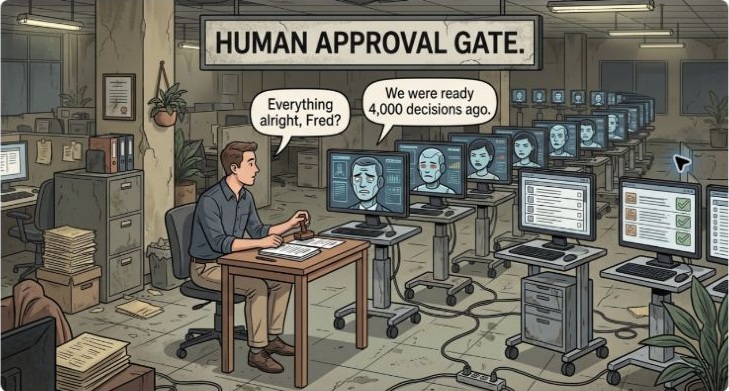
For the past several years, “human in the loop” has become the default answer whenever concerns are raised about artificial intelligence.
Who checks the AI’s work? A human.
Who prevents it from making a bad decision? A human.
Who remains accountable? Presumably, a human.
That may have been a reasonable starting point when generative AI primarily produced content, analysis, or recommendations. But agentic AI changes the problem. Agents can initiate actions, interact with systems, coordinate work, and make decisions across multiple steps of a process.
Putting a person somewhere inside that process does not, by itself, create control. In some cases, arbitrarily inserting a human creates the appearance of safety while introducing an entirely different set of risks.
Human Presence Is Not Human Oversight
A human reviewer can only provide meaningful oversight when that person understands what is being reviewed, has enough information to evaluate it, knows when intervention is required, and possesses the authority and ability to act.
Without those conditions, the human becomes little more than a checkpoint.
The most obvious problem is capacity. If every agent action requires approval, the human quickly becomes a bottleneck. As the volume and speed of activity increase, thoughtful review deteriorates into rubber-stamping.
But overload is only one way the human element can fail.
The Human May Automatically Trust the AI
People do not necessarily approach an AI recommendation with independent judgment. The recommendation can become the starting point for the decision, with the reviewer looking for reasons to agree.
NIST identifies this as automation bias, or excessive deference to an automated system. A human may technically retain the final decision while gradually surrendering the judgment behind it.
AI can also anchor the reviewer’s thinking. A 2025 study involving 775 managers found that AI-generated recommendations influenced performance-appraisal ratings. An employee’s evaluation could be affected not only by performance, but also by the recommendation presented to the manager.
Having a person make the final decision does not remove the system’s influence. The human may approve the answer, but the AI may have already framed how the person thinks about it.
The Human May Lose the Ability to Intervene
When AI performs the routine work, people have fewer opportunities to develop and maintain the skills needed to recognize and address unusual situations.
This problem predates generative AI. In her influential 1983 paper, “Ironies of Automation,” Lisanne Bainbridge described the paradox of leaving people responsible for abnormal conditions while automation removes them from the routine work that builds their experience.
An organization may claim that a human can always step in. But can that person understand what the system has done, diagnose why it failed, and recover the process under pressure?
The more capable the technology becomes during normal operations, the less prepared the human may be when intervention matters most.
The Human May Have Responsibility Without Authority
A reviewer may recognize a problem but lack the authority to stop the agent, reverse its actions, challenge the underlying policy, or contain the consequences. This creates an accountable person without creating meaningful human control.
Researcher Madeleine Clare Elish describes a related danger as the “moral crumple zone.” When a complex automated system fails, responsibility can be pushed onto the nearest human operator, even when that person had limited practical control.
The organization can then say that a person reviewed and approved the decision. That may protect the perceived integrity of the system, its designers, and its leaders. It does little to protect the employee who lacked the information, authority, or time necessary to prevent the failure.
The Human May Not Have Enough Context
A reviewer may receive an agent’s recommendation without knowing what information it considered, what it ignored, how confident it is, whether the situation falls outside normal patterns, or which guardrails were triggered. The agent may have already taken other actions the reviewer cannot see.
An approval request without this context is not meaningful oversight. It is a button.
AWS acknowledges this directly in its guidance for agentic systems. Its Agentic AI Lens states that human oversight is only effective when reviewers can make informed decisions without becoming overwhelmed or misled. It recommends providing the context needed to calibrate human attention, prioritizing high-risk decisions, monitoring for rubber-stamping, and containing agents that operate outside their intended boundaries.
AWS is not treating the human as the control system. The human is one component within a much broader control architecture.
The Process Must Define When the Decision Becomes Human Again
Effective control requires more than inserting an approval box into an existing workflow. Organizations must establish what an agent is authorized to do, which conditions require human intervention, and what information the reviewer needs. They must decide who receives an escalation, what authority that person has, and how the agent can be stopped, corrected, or contained.
The process cannot end when someone intervenes. The organization must understand why intervention was necessary and use that information to improve the agent, its guardrails, or the process itself.
These decisions cannot be left until something goes wrong. They must be designed into the process.
A 2026 AMCIS paper examining the evolution from rule-based automation to agentic AI places human-in-the-loop oversight within a broader model of supervised orchestration, monitoring, and control. Human involvement is not simply a person checking the final output. It is part of an intentionally designed relationship among delegation, execution, monitoring, and intervention.
This is why requiring a person to approve everything is not necessarily responsible governance. It can be fear masquerading as control.
A draconian approval loop may neutralize the value of the technology while doing little to improve decision quality. Humans become frustrated, independent judgment diminishes, and the organization concludes that the technology has failed. In reality, the process was never redesigned for a different kind of workforce.
We Will Not Return to an All-Human Workforce
We are the last generation of leaders to manage an entirely human workforce.
That does not mean people will disappear. It means work will increasingly be performed through some combination of human judgment and agentic execution. The challenge is no longer deciding whether humans or AI should perform the work. It is determining how responsibility should move between them.
McKinsey makes this point in its recent work on building HR for the agentic era. Rather than scaling disconnected AI pilots, McKinsey argues that organizations should define the future human-agent operating model and then work backward. Its HR example distinguishes among work executed by agents, outcomes owned by humans, and exceptional situations requiring human judgment.
That is process redesign, not task automation.
Agents are well suited to execution, continuous monitoring, pattern recognition, and work performed within defined boundaries. Humans remain essential where judgment, empathy, ambiguity, competing priorities, and accountability matter.
The objective should not be to keep a person wrapped tightly around every action an agent performs. It should be to create a system in which each contributes what the other cannot.
The organizations that succeed will redesign work around a deliberate and symbiotic relationship between people and agents. They will define where authority begins, where it ends, what happens when the system moves outside its boundaries, and when the decision becomes human again.
Human in the loop may be part of that strategy.
It is not the strategy itself.