Every week seems to bring another headline.
A company announces layoffs. AI appears somewhere in the explanation. Investors see productivity. Employees see another reason to worry that artificial intelligence is coming for their jobs.
Maybe it is.
But the more interesting question is whether AI is really eliminating these jobs, or whether companies are using AI to accelerate or rebrand workforce decisions that were already coming.
According to Challenger, Gray & Christmas, U.S. employers attributed 112,713 announced job cuts to AI through July 2026. Yet overall announced layoffs during the same period were 41% lower than a year earlier.
So AI is clearly changing the workforce. But “AI took the jobs” is probably too simple an explanation.
Before We Count the Savings
Meta offers a useful warning.
Reuters reported that Meta encountered productivity, reliability, security and employee-resistance problems as it tried to operate with smaller, AI-enabled teams, ultimately pulling back portions of the plan.
That matters because AI capability is not the same thing as business value.
Installing AI does not automatically create productivity, and removing people does not automatically create efficiency. If the work has not been redesigned, eliminating labor may simply move the problem somewhere else.
Who Are We Developing for Tomorrow?
There is another risk that gets much less attention.
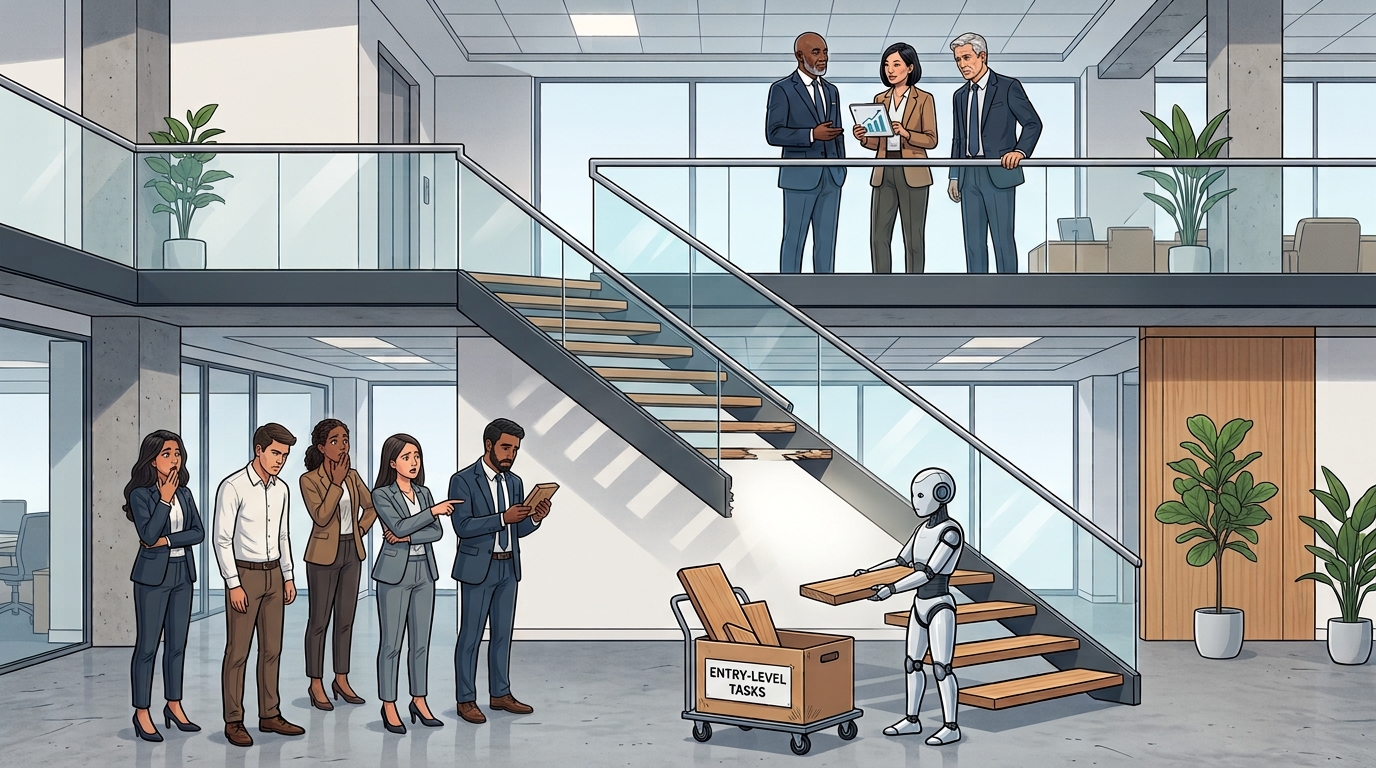
Many of the jobs AI is most capable of changing are also the jobs where people traditionally learned their profession. Analysts learned by doing analysis. Accountants learned by reviewing transactions. Consultants learned by researching, modeling and presenting.
Those jobs were not just labor. They were part of the system that created experienced workers and future leaders.
If AI removes significant portions of that work, we have to redesign that system too.
Reducing labor costs may improve today’s economics, but a company cannot sustainably improve performance by consuming capabilities faster than it develops them.
If we remove the lower rungs of the career ladder without creating another way for people to gain experience, judgment and institutional knowledge, we risk optimizing today’s workforce at the expense of tomorrow’s.
AI creates an extraordinary opportunity to eliminate unnecessary work and fundamentally redesign how organizations operate.
But sustainable transformation has to account for more than the work we can eliminate. It also has to consider the capabilities we still need to create.
So, is AI taking our jobs? Some of them, almost certainly. But the more important question for leaders may be:
If AI removes the work that taught people how to become experts, how are we going to create the next generation of experts?