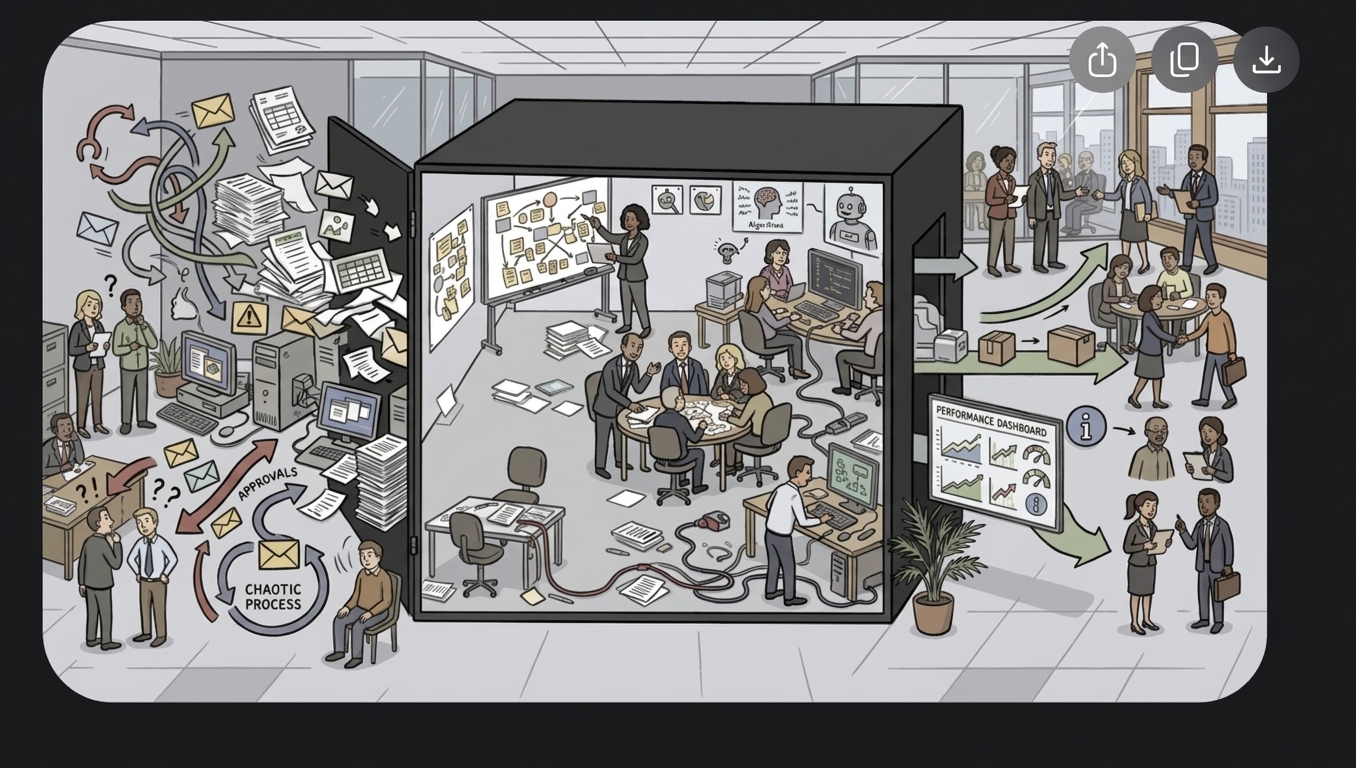
The companies beginning to capture meaningful value from AI appear to be learning the same lesson: technology is only one part of the transformation.
The real work happens in the middle, where strategy collides with existing processes, fragmented systems, unclear decision rights, competing priorities, and the practical realities of how work gets done.
Three recent developments point toward this shift.
Accenture and Google Cloud have formed the Accenture Gemini Enterprise Business Group, supported by a planned workforce of 1,000 forward-deployed engineers. The group combines technical capabilities with industry, functional, and implementation expertise to help clients move AI from experimentation into production and enterprise-scale transformation.
That combination matters.
Companies rarely struggle because they cannot find an AI model or identify a task that could be automated. They struggle because deploying AI inside a functioning business requires someone to understand the work, redesign it, connect systems, manage exceptions, establish controls, support adoption, and remain accountable for the outcome.
They need people who can operate in the messy middle.
The Process Must Become the Unit of Improvement
Its autonomous finance offering does not stop at invoice capture or three-way matching. It is designed to orchestrate the procure-to-pay lifecycle, from supplier onboarding and purchase requests through invoice processing, exception handling, and payment visibility.
That represents an important change in perspective.
For years, many automation programs have been built around individual activities. Organizations identified repetitive work, automated it, reported the hours saved, and moved to the next opportunity.
The result can be local efficiency without meaningful process improvement. An activity becomes faster while the customer still waits. A handoff is automated while the underlying approval remains unnecessary. More transactions reach a downstream team that cannot process them. The automation works, but the business constraint remains untouched.
The unit of improvement should be the business process and its constraint, not the individual activity that happens to be easiest to automate.
That means understanding:
- What outcome the process should produce
- Where work stops, waits, loops, or fails
- Which activities should be eliminated or redesigned
- Where human judgment creates value
- Where automation can improve flow, quality, or capacity
- How the resulting capacity will produce a measurable business outcome
The question is not simply, “What can we automate?” It is, “What should this process become, and what combination of people, technology, and AI will produce the best outcome?”
Capacity Created Is Not Value Realized
Wipro offers another important signal.
The company says its AI initiatives have produced productivity equivalent to the output of approximately 20,000 employees. But those employees were not simply eliminated. According to Wipro’s chief technology officer, they were redeployed into other projects, roles managing AI agents, and additional training.
She also made an even more important point: the focus must shift from productivity to outcomes. AI should ultimately be evaluated by whether it improves customer experience, creates revenue opportunities, and advances business goals.
AI can create capacity, but capacity is not automatically value. Value is realized only when leadership decides what to do with that capacity.
Reducing headcount may sometimes be economically necessary. But treating workforce reduction as the default measure of AI success risks converting a transformational opportunity into a short-term cost program.
The larger opportunity is to redeploy people toward work that creates greater value:
- Improving customer relationships
- Solving problems that have remained unaddressed
- Developing new products and services
- Strengthening quality and resilience
- Expanding into underserved markets
- Performing judgment-intensive work that technology cannot reliably own
This requires greater ambition from CEOs and other senior leaders.
The easiest business case may be the one promising immediate labor savings. The harder leadership challenge is determining how newly available capacity can create future revenue, stronger capabilities, better customer outcomes, or a more resilient organization.
Quarterly profitability still matters. But it cannot become an excuse to capture the smallest and most immediate benefit while leaving the larger opportunity for a future leadership team to discover.
Leadership Must Push Beyond Automation
The next phase of AI will not be won by the company that automates the most activities. It will be won by the company that best understands its work, redesigns entire processes around better outcomes, and deliberately combines human and technological capability.
When AI creates capacity, the first question should not automatically be, “How many positions can we remove?” It should be, “What can this organization now accomplish that it could not accomplish before?”
That is where AI moves beyond efficiency and transformation begins.