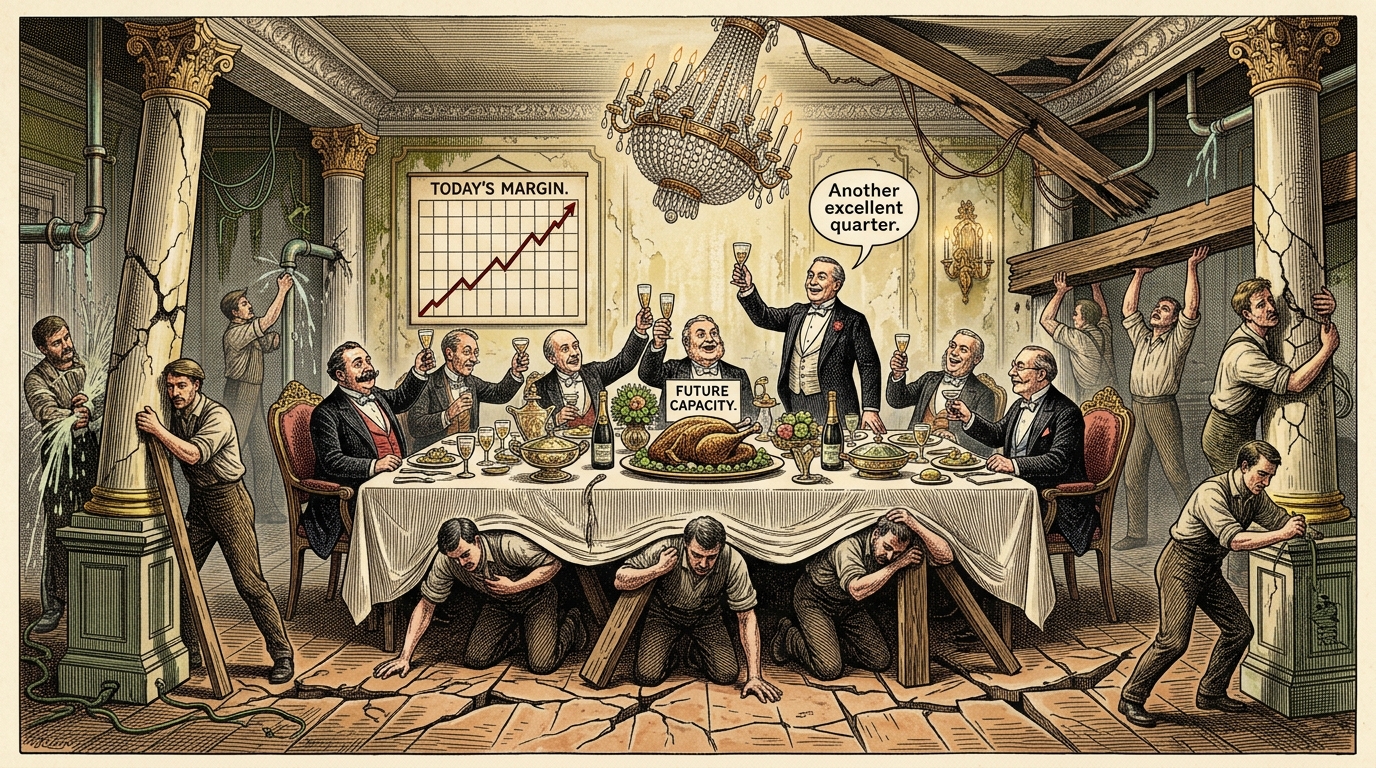
Business leaders have developed a familiar response to disappointing performance. Buy more technology. Demand more sales. Cut more costs.
Each move looks decisive on a presentation. Technology promises productivity. Higher sales targets promise growth. Budget cuts promise better margins.
But none of them necessarily fixes the business.
More technology and more sales are not the same thing, but leaders often use them the same way. Both become external answers to internal operating problems. When the expected results fail to materialize, the organization adds another tool, raises the target again, or removes another layer of cost.
Eventually, the company begins consuming the capacity it needs to recover.
That is what makes McLaren’s recently announced expansion worth examining.
The Investment Is Not the Interesting Part
The headline is that McLaren plans to invest £500 million in UK manufacturing and engineering, construct another assembly plant, develop more of its engines and transmissions internally, and launch its first SUV.
The more important story is what happened before the investment.
McLaren had too many vehicles sitting in dealer inventory. It reduced production, cleared excess stock, and moved toward building vehicles only when customers placed orders. That change was intended to limit discounting, protect residual values, and reconnect production with actual demand.
Sales declined during the restructuring. Leadership accepted that consequence instead of continuing to push vehicles into the market to preserve an attractive top-line number.
Only after addressing that operating problem did McLaren commit additional capital to new products, expanded manufacturing, and future growth.
That sequence matters.
McLaren did not begin by assuming that another technology platform would solve the problem. It did not treat higher sales targets as a substitute for understanding demand. It did not simply cut costs and declare the resulting margin improvement a transformation.
The company looked inward, identified how its operating model was undermining performance, and changed the way the business worked.
Then it pursued growth.
Cost Reduction Is Not a Growth Strategy
Companies sometimes need to reduce costs. McLaren itself reduced production while correcting its inventory problem. The question is whether leadership is removing waste or removing capability.
Reducing excess inventory because production is disconnected from demand can strengthen a business. Eliminating the people who develop products, serve customers, maintain critical knowledge, or provide operational resilience may improve the next quarterly report while weakening the company that remains.
Those actions can look identical on a spreadsheet. Their long-term effects are completely different.
Too many organizations now announce workforce reductions alongside ambitious claims about AI-enabled productivity. The underlying assumption is that technology will absorb the work, preserve service, and create enough efficiency to offset the loss of organizational capacity.
Sometimes that assumption will prove correct. Often, it has not been tested with enough discipline to deserve the confidence placed in it.
The process may still be broken. The data may still be unreliable. Decision rights may remain unclear. Work may continue to move through poorly designed handoffs. Employees may compensate for system failures that leadership has never bothered to understand.
Removing those employees does not eliminate the work. It eliminates the people holding the system together.
AI Cannot Replace Management
AI will create enormous opportunities, but it also gives weak leadership another place to hide.
It is easier to announce an AI initiative than to examine why the company struggles to make decisions. It is easier to purchase a platform than to clarify ownership. It is easier to reduce headcount than to redesign work. It is easier to promise productivity than to determine whether the organization has the data, processes, controls, and leadership discipline required to produce it.
None of that is transformation.
AI can improve a capable operating model. It can also accelerate confusion, reproduce bad decisions, and industrialize broken processes.
The difference begins with management.
Leaders must understand how the business currently creates value, where that system breaks down, and what customers will pay for next. Only then can they decide whether the answer is process redesign, new technology, a different operating model, additional talent, or a new product.
The tool comes after the diagnosis.
Growth Requires Something to Grow Toward
McLaren is not merely investing in more production capacity. It is expanding its product portfolio into a category with demonstrated demand.
The company may still get the bet wrong. An SUV does not guarantee profitable growth, and a large capital commitment does not guarantee execution.
But the direction is materially different from treating cost reduction as the destination.
McLaren is attempting to create new demand, build new internal capabilities, and reach customers it could not reach with its existing product portfolio. It is using the breathing room created by restructuring to pursue a larger opportunity.
That is the responsibility leaders cannot cut their way around.
A company needs the capacity to develop products, improve customer experiences, respond to disruption, and pursue new sources of demand. Protecting that capacity may occasionally depress short-term margins. Destroying it can make the business appear healthier immediately before it becomes less competitive.
Leaders Must Do the Homework
The winners in the emerging AI economy will not automatically be the companies that buy the most technology or eliminate the most positions.
They will be the companies willing to examine themselves honestly.
They will identify where their operating models create friction, where their processes undermine performance, and where their assumptions no longer match customer demand. They will allocate resources toward new products, better ways of working, and opportunities capable of producing durable growth.
They will use AI where it strengthens that work, not as an excuse to avoid it.
Investors and boards should expect more than another restructuring announcement followed by an AI promise. They should ask what operating problem leadership has identified, what evidence supports the diagnosis, what capabilities the company must preserve, and where future demand will come from.
Cutting costs can buy time.
Technology can create leverage.
Neither one determines what the business should become.
That remains the work of leadership.