OpenAI recently announced its new Agents API, a platform designed to help developers build agents that can continue working for hours or even days.
It is a product announcement, but the capabilities being promoted reveal something important about where agentic AI is heading.
Long-running agents require more than a capable model. They need persistent context, access to tools and files, coordination among subagents, intermediate storage, recovery mechanisms, and infrastructure that can keep the work moving.
That is the work around the model.
As these capabilities improve, organizations will be able to automate increasingly complex activities. They will also find it easier to mistake agent activity for business performance.
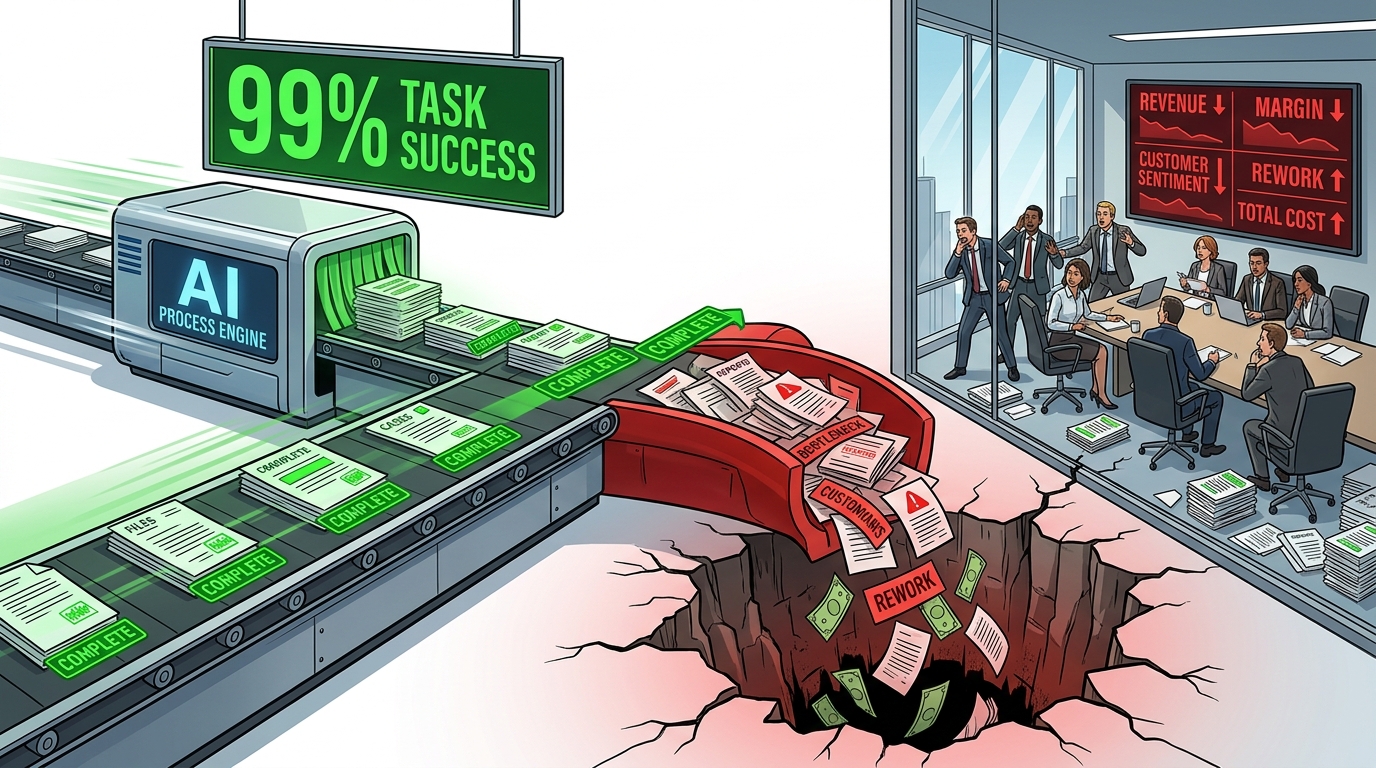
A completed task is not necessarily a successful process.
Agent Capability And Process Capability
Agent capability is the ability to reason, use tools, retain context, coordinate work, recover from problems, and complete an assigned task.
Process capability is the ability of the entire system, including people, technology, decisions, controls, and handoffs, to consistently produce the intended business outcome.
These are becoming separate variables.
A highly capable agent inserted into a weak process does not create a strong process. It may simply allow the weak process to operate faster, more frequently, and at greater scale.
The agent may successfully complete every assignment while the organization experiences more rework, a larger downstream bottleneck, higher supervision costs, or no meaningful improvement in the customer outcome.
Paying For Performance Is Not Paying For Value
Management teams have long been attracted to the idea of paying for performance. Digital work appears to make that easier because nearly every action can be counted. An agent completed a case. It generated a report. It processed a transaction. It resolved an exception.
Those measures confirm that something happened. They do not confirm that the business improved.
The task may become faster while the end-to-end cycle time remains unchanged. Output may increase while human review and rework grow with it. The cost of an individual transaction may fall while the total cost of operating the process rises.
Paying for performance only works when performance is defined at the right level.
If organizations define success as completed tasks, agents can produce an extraordinary amount of apparent performance. They can also create enormous cost sinkholes by generating activity that never becomes measurable value.
Measure The Process, Not Just The Agent
The more work agents perform, the more important it becomes to measure what happens across the entire process:
- End-to-end cycle time
- Exceptions and rework
- Total cost, including supervision and downstream activity
- Quality and customer outcomes
- Risk and control performance
- Whether saved time was reclaimed or redeployed
- Whether the expected financial value was captured
Before scaling an agent, leaders should ask:
Long-running agents do not reduce the need for process improvement. They make process improvement more important.
Organizations that understand the difference between agent capability and process capability will use agents to redesign how value is created. Those that do not may end up paying for an extraordinary amount of digital performance without receiving an extraordinary amount of business value.
A completed task is not automatically a successful process. Agent performance is not automatically business performance.