Why hire someone like me, or any other process engineering firm, anymore?
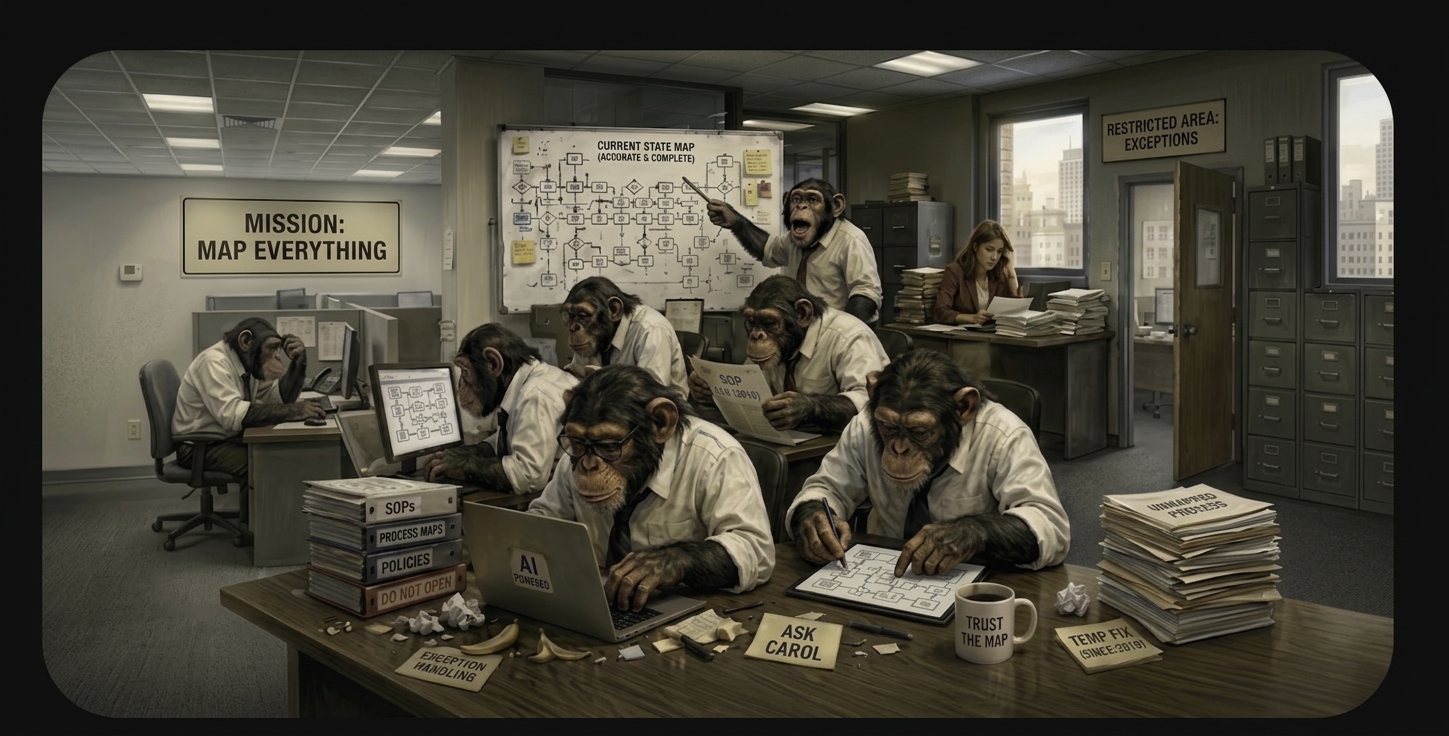
AI is making process mapping so easy that almost anyone can produce a map, regardless of their training or methodology. Feed the machine an SOP, a transcript, some screenshots and a little system data, and it can produce a polished current-state map in a fraction of the time it once took.
The problem begins when we confuse mapping the process with understanding the process.
The real value was never in drawing the boxes and arrows. The value was in the discovery required to understand what belonged inside them.
Most organizations do not operate from pristine, continuously maintained documentation. They have SOPs written at the start of a project, old process maps, training materials, system workflows and a tremendous amount of institutional knowledge that lives only inside people’s heads.
That is where the real process often hides.
Anyone who has done this work long enough has heard some version of: “Well, that’s what the procedure says, but that’s not really how we do it.”
That sentence matters.
A good practitioner starts digging.
- What actually happens when the system rejects the transaction?
- Why is someone maintaining a spreadsheet outside the system?
- What changes at month-end, quarter-end or during a volume spike?
- Why was this approval added in the first place?
- Which workaround has quietly become the real process?
- What does everyone know that was never written down?
AI can help us ask these questions faster and analyze the answers at a scale we could not touch before. But AI cannot discover evidence it was never given.
That creates a new risk.
AI can take incomplete source material and turn it into something polished, logical and authoritative-looking. The quality of the presentation can suddenly exceed the quality of the underlying evidence.
Every strange approval, duplicate entry, manual report and awkward handoff probably came from somewhere. Some were responses to system failures. Some came from customer complaints. Some were added for legitimate controls. Others survived long after the problem they were meant to solve disappeared.
If we do not understand that history, we can easily remove something important, automate a workaround or design a future state around a false assumption.
That is where this becomes deadly. We industrialize the misunderstanding.
We take a partial version of reality, formalize it, automate it and scale it. Eventually, the misunderstanding is no longer sitting inside a dusty process document. It is running the business.
This is why I see AI as an extraordinary tool for process practitioners, not a replacement for them. Let AI handle more of the mechanical work. Let it summarize, organize, compare, map and search.
That gives us more time to do the work that matters most: question, investigate, validate and understand.
As process mapping gets cheaper, judgment becomes more valuable.
Because drawing the process was never really the hard part.
Understanding the business was.